Last May, a homeowner in Howell called us about a backyard paver patio. The shaded side had a green film. There were weeds growing from the joints near the steps, and the whole patio had started looking dull.
They had a graduation party coming up and had been told that the pavers should be sealed.
The first question was simple.
How much is this going to cost?
That question comes up often enough that it is worth explaining the whole job, not just the price of the sealer.
For a typical Livingston County paver patio, the full cost of cleaning, replacing joint sand and sealing can land around $2 to $4 per square foot. A 400 square foot patio can therefore cost roughly $800 to $1,600 for the complete process. Cleaning alone is commonly around $0.30 to $0.60 per square foot, although actual quotes depend on the surface and condition.
One important point about our role is worth making clear. We clean pavers. We do not seal them or install polymeric sand. Our part is the cleaning and preparation that needs to happen before another contractor applies the sand and sealer.
That distinction matters because a sealer cannot hide poor preparation.
We have seen enough dirty patios, algae covered joints and damp surfaces to know that the preparation stage can make a major difference in the final result.
How much does paver sealing cost in Livingston County?
Most Livingston County homeowners can expect to spend about $2 to $4 per square foot for a complete paver cleaning, resanding and sealing project. A 400 square foot patio may therefore fall around $800 to $1,600. Cleaning alone is often around $0.30 to $0.60 per square foot. Old sealer removal, paver repairs, releveling and larger driveways can increase the total.
These are typical 2026 ranges based on current cost research and commonly quoted project ranges. They are not a Livingston Pressure Washing price list.
The final cost depends on what the pavers need before sealing.
A relatively clean patio with stable joints is very different from a patio with algae, old sealer, weeds, missing sand and areas that have settled.
That is why two homeowners with patios that look similar from the street can receive very different quotes.
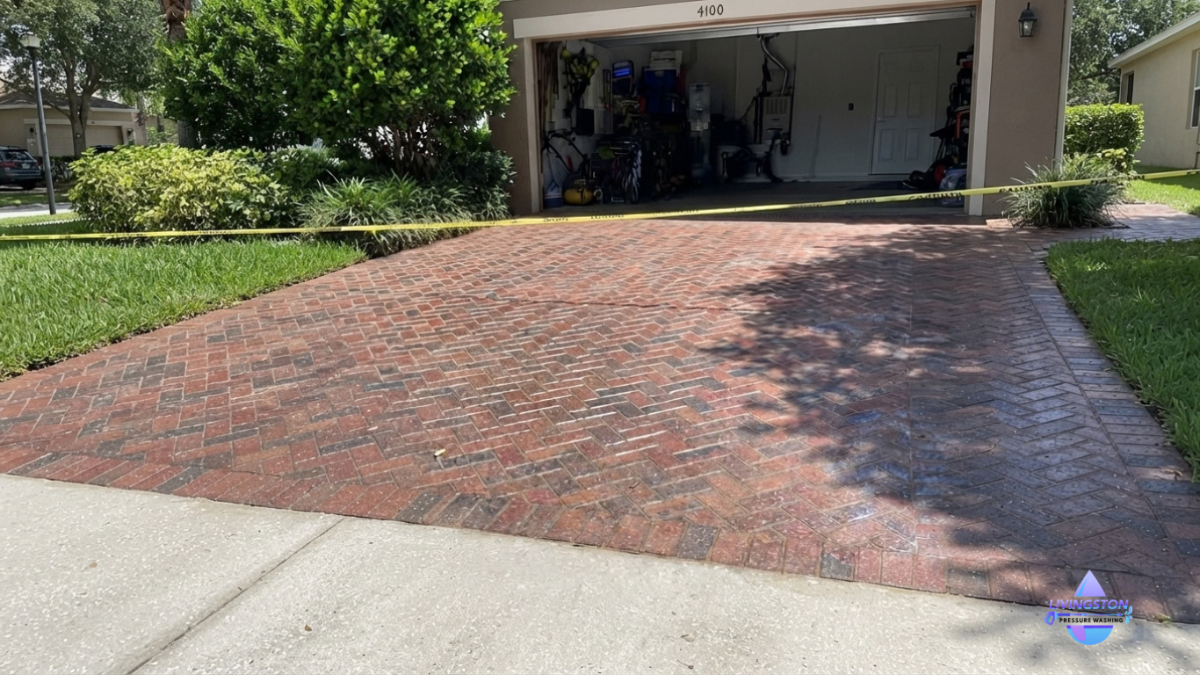
What does each step of a paver sealing job cost?
A proper paver sealing project is really several jobs performed in the correct order.
The basic sequence is cleaning, joint sand work and sealing.
Livingston Pressure Washing handles the cleaning and preparation portion. Sand installation and sealing are separate services.
| Step | Typical 2026 cost | What it includes |
| Deep paver cleaning | $0.30 to $0.60 per square foot | Detergent, surface cleaning and rinsing |
| Polymeric sand | About $0.25 to $0.75 per square foot | Sand installation, compaction and misting |
| Sealer | About $1.25 to $2.50 per square foot | One or two coats depending on product |
| Old sealer removal | Quoted by project | Needed when existing sealer is cloudy or peeling |
| Paver releveling | Quoted by area | Repairs for settled or uneven sections |
The numbers above are useful for understanding where your money goes.
They should not be treated as a guaranteed local quote.
Paver cleaning cost
Cleaning is usually the first and smallest part of the complete project.
The price can change based on square footage, algae and moss, staining, steps, edges, walls, accessibility and the amount of buildup.
A patio with light dirt is straightforward.
A shaded patio with years of algae, weeds and embedded grime takes more preparation.
At Livingston Pressure Washing, we use cleaning methods based on the surface rather than simply turning the pressure up. Our website explains that we use the correct pressure depending on the area and cover plant life when necessary.
That matters with pavers because aggressive cleaning can disturb loose joint sand.
Polymeric sand cost
Polymeric sand is used in the joints between many pavers.
It is swept into the joints, compacted and activated according to the product instructions.
The purpose is not simply cosmetic. Proper joint material helps stabilize the pavers and can reduce the opportunity for weeds and ants to establish between them.
Cleaning can remove loose or contaminated sand from the top of the joints. That is not necessarily a problem.
In fact, it is often part of the preparation.
The important thing is that the joint sand is replaced correctly afterward by the contractor handling that part of the project.
Sealer cost by type
Sealer prices vary considerably depending on the product and the type of finish you want.
Common categories include water based acrylic, solvent based acrylic and penetrating silane siloxane products.
Some sealers enhance color and create a wet look. Others are designed to be less visible and more breathable.
The amount of product required also changes with the paver surface.
A textured paver can require more product than a relatively smooth surface.
This is another reason a simple price per gallon does not tell you what the completed project will cost.
One of the things we hear from homeowners is that they want a clean patio first because they do not want to spend money sealing dirt, algae or residue into the surface.
That is a reasonable concern.
How much does it cost by patio or driveway size?
Square footage gives you a useful starting point.
The table below shows broad planning ranges for cleaning alone and for the complete cleaning, sand and sealing process.
| Area | Size | Cleaning only | Full clean, sand and seal |
| Small patio or walkway | 150 sq ft | $75 to $150 | $300 to $600 |
| Standard patio | 320 sq ft | $100 to $190 | $640 to $1,280 |
| Patio plus walkway | 400 sq ft | $120 to $240 | $800 to $1,600 |
| Large patio with fire pit | 600 sq ft | $180 to $360 | $1,200 to $2,400 |
| Two car paver driveway | 700 sq ft | $210 to $420 | $1,400 to $2,800 |
| Large paver driveway | 1,000 sq ft | $280 to $500 | $2,000 to $3,500 |
Small projects can also have minimum service charges, so multiplying a tiny patio by a per square foot rate does not always produce the actual quote.
Larger projects can have a lower effective price per square foot because setup, travel and equipment costs are spread across more surface area.
A paver driveway also deserves separate consideration.
It receives vehicle traffic, road salt, tire marks and more frequent contamination than a backyard patio. That can affect both preparation and the type of sealer a contractor recommends.
If you are comparing the cost of cleaning a paver driveway with regular driveway washing, keep the scope separate. A paver sealing project involves more than simply washing the surface.
Why does cleaning and preparation decide how well the sealer works?
If you are going to spend hundreds or thousands of dollars sealing pavers, the surface needs to be properly prepared first.
The basic rule is simple.
Do not seal over dirt, algae, salt residue or moisture.
Sealer locks in what is underneath
Sealer is not a magic eraser.
If there is algae, dirt, oil or other residue on the surface when the sealer is applied, you can end up preserving the problem instead of fixing it.
This is especially noticeable on patios that have spent years under trees or on the north side of a home.
One of our customers, Heather Kufahl, described how much difference cleaning made on her property:
“My house looks like new, especially the north side which had a lot of algae build up. Big thanks to Mike and Justin’s meticulous attention to detail.”
That kind of north side buildup is common in areas where surfaces receive less direct sunlight.
Moisture can cause cloudy sealer
Pavers need to be properly dry before sealing.
Applying a film forming product over trapped moisture is one reason homeowners sometimes end up with a cloudy or hazy appearance.
After cleaning, the pavers may need at least 24 to 48 hours of suitable dry weather, depending on conditions and the sealer manufacturer’s instructions.
Do not use a generic drying time as a guarantee.
The product label and actual weather conditions should control the decision.
Efflorescence needs attention
That white haze you sometimes see on concrete pavers can be efflorescence.
Mutual Materials explains that efflorescence is a natural result of chemical reactions involving moisture and materials within concrete. It is generally an aesthetic issue rather than a structural problem.
The important part for sealing is timing.
If the surface needs efflorescence cleaning, that should happen before sealing.
Joint sand can wash out
This is one of the biggest concerns homeowners have.
Will cleaning remove sand?
Some loose sand can come out during a proper cleaning. That is normal.
Dirty, loose or weed filled sand at the surface may need to be removed before fresh joint sand is installed.
The answer is not to avoid cleaning.
The answer is to clean the pavers correctly and then have the joints restored by the contractor handling the sand work.
Our approach is to use the correct pressure for the area rather than treating every surface the same. We also take precautions around surrounding plant life.
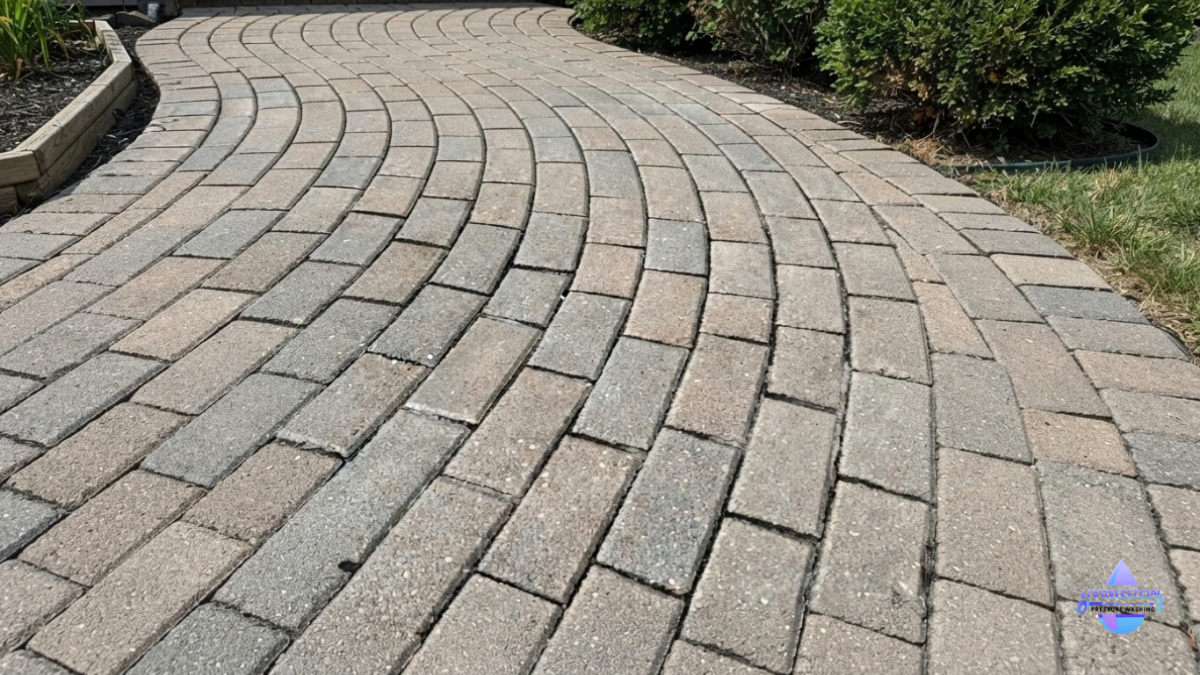
Getting your pavers ready for sealing?
We clean pavers so your sealer, or your sealing contractor’s sealer, has a clean surface to work with.
We do not install polymeric sand or seal pavers ourselves.
If you are planning to seal after cleaning, tell us that when you request an estimate. We can discuss what we can handle and help you plan the cleaning around the next stage.
Call 810 360 1002 or request a free estimate.
New customers can mention First Time Offer for $100 off.
How do Michigan weather and local conditions affect paver sealing cost?
Livingston County has a very different sealing environment from a warm climate where outdoor surfaces can stay dry for long periods.
Our timing matters.
The sealing window is limited
Many sealing products and polymeric sands need dry pavers, suitable temperatures and a period without rain.
Exact requirements vary by product, but homeowners generally need to plan around a stretch of warm, dry weather.
For Michigan, late spring through early fall is typically the practical window.
That means it can make sense to clean earlier in the season.
If you wait until the middle of summer to start everything, you may find that sealing contractors are already booked.
Freeze thaw cycles affect joints
Water gets into joints.
When temperatures fall below freezing, that moisture expands.
Repeated freeze thaw cycles can contribute to movement and joint loss, particularly where drainage, base conditions or joint material are already compromised.
Polymeric sand and appropriate sealing can help stabilize the surface, but they do not correct a failed base or badly settled section.
If pavers have moved significantly, the project may need hardscape repair before cleaning and sealing.
Road salt matters on paver driveways
Paver driveways in Brighton, Howell and surrounding areas deal with winter road salt and deicing products.
That can leave a white residue on the surface.
Mutual Materials notes that concrete pavers have strong freeze thaw resistance and generally tolerate deicing salts better than many pavement surfaces.
Still, residue should be addressed before sealing.
A paver driveway with salt deposits and a patio with algae have different cleaning requirements.
Shade and humidity affect drying
Heavy tree cover can mean more leaves, organic debris and algae.
North facing areas often stay damp longer.
Homes around areas such as Lake Chemung and Whitmore Lake can also experience conditions where drying takes longer after cleaning.
That matters because cleaning and sealing are not necessarily a same day process.
How long does sealer last?
A reasonable planning range for many film forming sealers is around 2 to 4 years on patios, with driveways potentially requiring more frequent attention because of vehicle traffic and exposure.
The actual lifespan depends on the product, application, weather, traffic, surface preparation and maintenance.
Cleaning the surface regularly can help keep it looking good between sealing projects.
A real world example: a Howell patio and walkway
Here is how the numbers can look on a roughly 400 square foot project.
Imagine a 16 by 20 foot backyard patio.
That gives you 320 square feet.
Add a 3 by 25 foot walkway and you have another 75 square feet.
Round that to about 400 square feet.
Now imagine the shaded side has green algae and the joints near the steps have weeds.
There is no old sealer to strip.
The cleaning portion at $0.30 to $0.60 per square foot would be approximately $120 to $240.
Polymeric sand at about $0.25 to $0.75 per square foot would be around $100 to $300.
Sealer at approximately $1.25 to $2.50 per square foot would be around $500 to $1,000.
That produces an estimated total of roughly $720 to $1,540.
The actual contractor quote can be different because product choice, access, minimum charges, repairs and surface condition all matter.
For comparison, published national cost guides show similar broad ranges for projects of this size.
Now consider a 700 square foot two car paver driveway.
A full cleaning, sand and sealing project might land around $1,400 to $2,800, with cleaning representing approximately $210 to $420 of that planning range.
Again, these are planning numbers rather than an LPW quote.
Wet look or natural look: does the sealer type change the price?
Yes.
The finish you want can influence both product selection and cost.
| Finish | General appearance | Consideration |
| Natural or matte | Little visible change | Often preferred when a subtle finish is wanted |
| Wet look | Darker and more color enhanced | Can make pavers look richer and more dramatic |
| Penetrating sealer | Minimal surface film | Useful when breathability and water management are priorities |
| Acrylic sealer | Can enhance color | Application and moisture control are important |
A wet look sealer can make older pavers appear much more colorful.
But that does not automatically make it the right choice.
If moisture conditions are difficult, or the homeowner wants the surface to retain a natural appearance, another product may make more sense.
Always ask the sealing contractor what product they plan to use and why.
Is it worth sealing pavers in Michigan?
There is no single answer for every homeowner.
Some homeowners like the added color, stain resistance and easier maintenance that a good sealer can provide.
Others prefer to clean their pavers regularly and leave them unsealed.
The honest pros include:
- Enhanced color and appearance
- Easier routine cleaning
- Additional resistance to some stains
- Improved joint stability when the right joint stabilizing system is used
- Reduced opportunity for weeds in properly prepared joints
There are also downsides.
Sealing costs money.
It needs to be maintained.
Poor application can result in clouding or other appearance problems.
And some homeowners simply prefer the natural appearance of unsealed pavers.
Our view as a cleaning company is straightforward.
Some of our customers seal. Some do not. Either way, a clean patio is where it starts.
Can you clean and seal pavers yourself?
Yes, but there are several places where DIY projects can go wrong.
You may need a pressure washer rental, surface cleaner, paver cleaning product, polymeric sand and sealer.
The equipment and material cost can look attractive at first.
The risk is in the technique.
Common problems include:
- Blasting joint sand too deeply
- Etching the paver surface
- Leaving cleaning residue behind
- Applying polymeric sand incorrectly
- Creating polymeric sand haze
- Applying sealer while the pavers are damp
- Applying too much sealer
- Creating uneven coverage
The middle ground can work well for some homeowners.
You can have the pavers professionally cleaned and then handle the sealing yourself if you are comfortable following the sealer manufacturer’s instructions.
If you are deciding between equipment rental and hiring a professional for the cleaning portion, compare the total time, equipment and risk rather than looking only at the rental price.
What should you ask a paver sealing contractor?
Before agreeing to a quote, ask a few simple questions.
- Is cleaning included in the price?
- How thorough is the cleaning?
- Will old sealer need to be removed?
- How long will the pavers dry before sealing?
- What type of joint sand will be installed?
- What sealer product will be used?
- How many coats are included?
- What happens if the sealer clouds?
- Is the company insured?
- What happens if rain interrupts the scheduled application?
- Will damaged or settled pavers be repaired before sealing?
- Does the quote cover the entire process or only the sealing step?
The goal is to compare the scope, not just the final number.
A $1,000 quote and a $1,400 quote may represent very different levels of preparation.
What does a paver cleaning visit from Livingston Pressure Washing look like?
We keep the process simple.
First, you send us your address and tell us what needs to be cleaned.
That might be a paver patio, walkway, driveway, steps or another exterior surface.
Then we schedule a date.
You do not necessarily need to be home. Our website explains that customers can provide the address and areas to be cleaned, then choose a date.
When we arrive, we look at the surfaces and surrounding areas.
Plants can be covered when necessary.
We use appropriate cleaning solutions and equipment based on the surface.
The goal is to remove the algae, mildew, dirt and grime without treating a delicate area like a concrete driveway.
Our website specifically notes that we use the correct pressure depending on the area and take precautions around plant life.
We also do not use harsh chemicals that compromise the structure or can harm pets or family members.
One customer, Donna Dodd, described the experience this way:
“They did a fantastic job on both ours and the neighbors home. They were respectful of our property and were professional and friendly.”
Another customer, Edward Powell, mentioned the quick turnaround from quote request to scheduling.
Most importantly, we want to be clear about scope.
We do not sand or seal pavers.
If you already have a sealing contractor, we are happy to discuss timing the cleaning so the surface has enough time to dry before their scheduled work.
Frequently asked questions about paver sealing cost
How much does it cost to seal pavers?
For planning purposes, expect about $2 to $4 per square foot for cleaning, joint sand and sealing together. Larger or more complicated projects can fall outside that range.
How much is paver cleaning alone?
A broad planning range is around $0.30 to $0.60 per square foot. Actual cleaning cost depends on size, access, algae, stains and the condition of the pavers.
Do pavers need to be cleaned before sealing?
Yes.
The surface should be clean before sealing. Dirt, algae, stains and efflorescence can affect the appearance and performance of the finished surface. Manufacturer guidance also recommends cleaning before sealing or joint stabilization.
How long after cleaning can pavers be sealed?
The pavers should be completely dry.
A common planning window is 24 to 48 dry hours, but weather conditions and the specific sealer instructions should determine the final timing.
How long does paver sealer last in Michigan?
Many film forming sealers can last around 2 to 4 years on patios, although driveways can require more frequent maintenance. Product choice, traffic, weather and preparation all affect lifespan.
When should new pavers be sealed?
Ask the paver installer and sealer manufacturer first.
New pavers can experience efflorescence, which is a natural process in concrete. Waiting until the appropriate time helps avoid sealing over a developing surface issue.
Does sealing stop weeds?
Sealing alone does not guarantee that weeds will never return.
Properly installed polymeric sand can help stabilize joints and reduce weed growth, but maintenance is still necessary.
What is the white haze on my pavers?
It may be efflorescence or salt residue.
Efflorescence is a natural white haze associated with concrete pavers and moisture. It is generally an aesthetic issue, but it should be addressed before sealing.
Does Livingston Pressure Washing seal pavers?
No.
We provide paver and patio cleaning and preparation. We do not install polymeric sand or apply paver sealer.
If you are planning a sealing project, call us and ask what we can handle.
What is the best time to seal pavers in Livingston County?
Late spring through early fall is generally the practical window, provided the weather meets the product requirements.
A warm, dry stretch is more important than choosing one specific calendar date.
Start with a clean surface
If you are comparing paver sealing costs, do not look only at the sealer price.
Look at the whole process.
Cleaning removes the surface contamination that you do not want underneath the sealer. It also gives you a chance to identify loose sand, stains, algae, efflorescence and areas that may need repair.
At Livingston Pressure Washing, that is the part we know.
We clean patios, pavers, brick, specialty stone, driveways and other exterior surfaces using professional equipment and surface appropriate methods. Our service process is built around a free estimate, scheduled service and satisfaction guaranteed.
If your pavers are in Howell, Brighton, Hartland, Fowlerville, Pinckney, Hamburg or another nearby Livingston County community, contact us before your sealing date.
We can clean the surface and help you understand what we can handle.
Call 810 360 1002 or request a free estimate.
Mention First Time Offer and new customers can receive $100 off.