Is it safe to pressure wash a composite deck? Often yes, but only within limits. Makers set strict rules, and some warn that a pressure washer can void the warranty. Most of the cleaning is done by a cleaner and a gentle rinse, not by force.
One homeowner told us, almost apologetically, “I was told composite never needs cleaning.” If that is you, you are not alone, and nothing is wrong with you or your deck. This guide covers the maker rules, why composite gets dirty, and how we clean decks in Howell and across Livingston County.
Is It Safe to Pressure Wash a Composite Deck? The Short Answer
It can be safe if you follow the maker’s rules: a low pressure setting, a wide fan tip, a safe distance, and spraying with the grain. Some makers warn that pressure washing can void the warranty, so check your maker’s rules first. A gentle cleaner with a low pressure rinse is usually the safer way.
Not sure which brand or line you have? Call 810 360 1002 and we will check at your free estimate.
What Do Trex, TimberTech and AZEK Say About Pressure Washing?
Each maker has its own rules, and those rules come before anything we say. Please treat every number below as maker guidance that you should check on your maker’s current page.
What Does Trex Say?
The figures here are what major publications report Trex saying, so confirm them on the Trex site for your line. House Digest reports that Trex says to use no more than 3,100 PSI on pressure washer compatible decking, to use a fan tip, and to hold it at least 8 inches above the boards. It also quotes Trex warning that a pressure washer could damage the deck surface and void the warranty. You can read it in House Digest’s piece on Trex decking.
Family Handyman reports Trex suggesting about 1,500 PSI for basic cleaning, and up to 3,100 PSI only for serious cleaning on newer lines. It adds that Trex does not recommend pressure washing older lines at all, and that Trex says pollen can feed mold. See their guide to cleaning Trex decking.
Treat 3,100 as a ceiling, not a target. Confirm your own line on the Trex site.
What Does TimberTech Say?
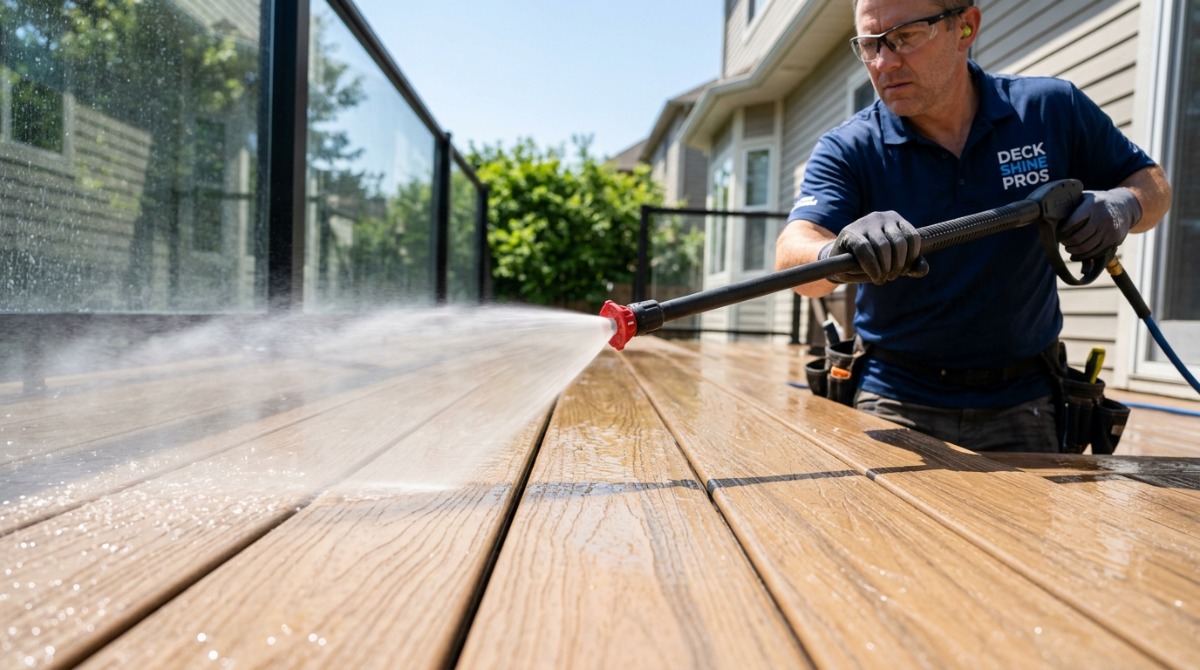
TimberTech’s own care and cleaning page is clear. It says a power washer can be used for rinsing only with TimberTech products. The maximum is 1,500 PSI, and it calls for a fan tip nozzle. It tells you to spray in the direction of the grain pattern, never across the grain or the width of the board.
For some specialty and discontinued TimberTech products, the page also says to leave gaps between boards so water can drain and mildew is less likely.
What About AZEK and Other Brands?
AZEK and other makers publish their own care guides. Look up your brand and your line, and read what they say. We do not state numbers for brands we have not checked.
Why Do the Numbers Differ?
Makers, lines and board ages are different, and articles often mix them up. A ceiling is not a recommendation. A good rule of thumb is to use the lowest pressure that rinses, and the lower figure when you are unsure.
Think of the pressure washer as a rinse tool and not a scrub tool. The cleaner and a soft brush do the loosening, and the water simply carries the dirt away. When you work that way, you rarely need to go anywhere near a maker’s ceiling.
How Do You Pressure Wash Composite Safely, If the Maker Allows It?
Use low pressure, a wide fan tip, a safe distance and the grain. Here is the short list:
- A wide fan tip, never a narrow or pinpoint tip
- The lowest pressure that rinses
- A safe distance, starting farther away than you think
- A pass along the grain, not across it
- A test on a hidden spot first
Which Tip and Distance Should You Use?
Use a wide fan tip. Distance guidance varies by source and by washer. House Digest reports at least 8 inches for Trex, while other guides say 12 inches or more. Start farther away and test a hidden area before you commit.
Why Does the Direction of the Spray Matter?
TimberTech says to spray with the grain pattern and never across the width. Spraying across can lift edges and force water into the gaps between boards.
What Damage Does a Narrow Tip or Close Distance Cause?
A narrow tip held close can leave etched lines, swirl marks and a damaged cap, and it can push water into the board gaps. We once saw a deck marked with lines from a past DIY wash. Those marks do not come out, so prevention is the only fix.
Why Does Composite Decking Get Moldy and Slippery?
Mold grows on what sits on the surface, not in the board itself. That is the key idea, and it explains most of what you see.
What Do Mold and Algae Feed On?
Pollen, leaves, dirt, grease and moisture. Trex says pollen can feed mold. Our deck and patio cleaning page says composite tends to get dirty faster than regular wood, and that composite that is not cleaned correctly can get permanent staining.
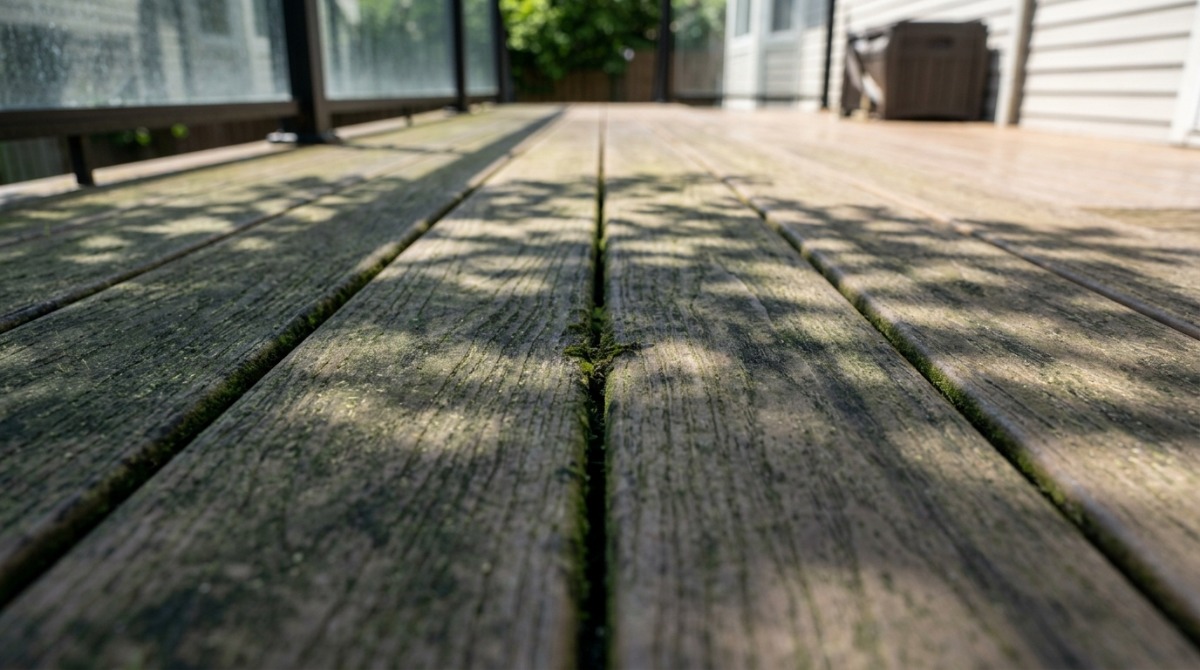
Picture a shaded back deck with a pollen film, leaf tannins and green growth at the board gaps. The growth is on the surface, and it feeds on what lands there.
Why Does the North Side or Shaded Deck Go Green First?
Shade keeps boards damp. Michigan humidity, wooded lots and lakes add to it, and leaves bring tannin stains. A deck under trees will usually need attention sooner than one in full sun.
Are Capped and Uncapped Boards Different?
Capped boards have a protective outer layer. Older uncapped or first generation boards are more porous, and they are the ones makers tell people not to pressure wash. We once visited an older deck where the surface looked chalky and porous. Age and board type change how gentle we must be.
Check your board line and age. A cap does not make a deck immune to dirt.
Will Pressure Washing Void My Composite Deck Warranty?
It might, depending on the maker, so check before you wash.
What Do Makers Say About Warranties?
House Digest quotes Trex saying that a pressure washer on your deck surface could damage the surface and void the warranty. Decks.com says premium composites such as Trex do not typically require pressure washing, and that high powered washing may void the warranty on many composite products. Its guide to pressure washing a deck tells readers to review the manufacturer’s cleaning guidance first.
TimberTech’s page does not address warranty. Read your own warranty, because these are only examples.
Keep simple records too. Take before and after photos, save your receipts, and note the date of each cleaning. If a question about your deck ever comes up, a short record is easier to share than a memory, and it shows you took care of the boards.
What Should You Do Before Cleaning?
Find your paperwork and your brand and line, then read the care page. Take before photos. If you are unsure, call the maker. We do not claim our method protects your warranty, so please read your warranty first.
How Do We Clean Composite Decks at Livingston Pressure Washing?
We start with the brand and condition of the deck, then use a gentle cleaner and low pressure. We ask you to tell us about delicate surface issues beforehand, as our Terms and Conditions say.
What Do We Check Before We Start?
We ask about the brand and line if you know it, the age of the deck, any loose boards, and any warranty concerns you want to flag. That helps us choose how gentle to be.
What Do We Use?
Our site describes custom, in house, environmentally friendly detergents that are safe for wood, composite and specialty stone. We apply them and rinse at low pressure. We do not publish pressure numbers, because the right setting depends on the deck.
What Do We Do Differently From a Rental Washer?
A rental washer is easy to use wrongly, with a narrow tip, a close distance or a pass across the grain. We use a wide tip and a steady distance, and we work with the grain. We avoid hot spots, go gently on edges and gaps, and rinse the debris out of the gaps. We also protect the plants and the house wall.
How Do We Handle Stains?
Some stains lift easily, such as pollen film and green growth. Others need more time, such as leaf tannin and deep organic stains. Our terms say there is no guarantee on complete removal of deep organic stains, rust or oil. We say that plainly, because mold stains can look like board damage and may need more than one visit.
See our before and after Trex deck photos on the deck and patio page or in our gallery, then use the quote form on our contact page.
Practical Examples: Three Composite Decks in Livingston County
These are common situations and how we think about each. They have no names or numbers.
A Shaded, Wooded Back Deck With Green Growth and Pollen Film
We look at how much growth sits in the gaps and how damp the deck stays. We go gentle, because the dirt is the problem and the boards are fine. We tell the owner that the growth will likely return in the shade, and that sweeping and rinsing help.
An Older Composite Deck With a Chalky or Porous Look
Age matters here. We ask about the board line, and we take extra care. We tell the owner that cleaning will help but cannot rebuild a worn surface.
A Newer Trex Deck With a Few Leaf Tannin and Grease Marks
We treat the marks with patience and a gentle method. We tell the owner that some marks may fade over more than one visit, and that a few may stay. When the film is gone and the color comes back, owners are often surprised at how much of the original color was hidden. The dirt was the problem, not the boards.
What Happens on Service Day at Livingston Pressure Washing?
Here is how a composite deck visit runs.
Before We Arrive
Move furniture, planters, grills and mats off the deck, as our terms ask. Keep pets and children away from the work area. We also need clear access to your water.
During the Cleaning
We inspect the deck and protect the plants and the house wall. We apply the cleaner, agitate gently where needed, and rinse at low pressure with the grain. Then we clear the gaps.
After the Cleaning
We look over the boards with you if you are home, and point out any stains that may need another visit. We share aftercare tips.
How Often Should You Clean a Composite Deck and How Do You Keep It Clean?
Plan on at least a yearly cleaning, and more in shade. This is general advice, not a rule.
What Does a Michigan Cleaning Calendar Look Like?
After spring pollen, and again before the first snow. Family Handyman reports that Trex recommends maintenance cleaning in the spring and again shortly before the first snowfall. Decks under heavy tree cover may need a second cleaning in fall, after the leaves come down.
What Can You Do Between Cleanings?
- Sweep the deck often.
- Rinse with a garden hose.
- Remove leaves from the gaps.
- Wipe spills quickly.
- Use a plastic shovel in winter.
- Avoid deicing salts, and keep calcium chloride off fasteners.
A customer once asked how to stop the green from returning. The answer is sweep, rinse, keep leaves off, and clean on a schedule.
Frequently Asked Questions
Can you pressure wash Trex decking?
Newer lines can be washed within Trex limits, and older lines should not be pressure washed. Check Trex’s current page for your line before you use a pressure washer.
What PSI is safe for composite decking?
Maker ceilings differ. For example, TimberTech states 1,500 PSI for rinsing only. Use the lowest pressure that works, and verify the limit for your brand.
Will pressure washing void my composite warranty?
It can with some makers. Read your warranty, and ask the maker before you wash.
Can you use bleach on a composite deck?
Advice online is mixed, so follow your maker’s cleaner list. We use a gentle cleaner chosen for composite, and we do not name chemicals for it.
Why does my composite deck have mold?
Mold grows on pollen, dirt and damp on the surface. It does not mean the boards have failed.
How often should I clean my composite deck?
At least once a year, and more under trees. A shaded deck with leaf litter will usually need it sooner.
Does cleaning remove all stains?
No, not always. Deep organic stains, grease and rust may remain, and our terms say so.
Is it better to hire a pro or use a rental washer?
A rental washer is easy to use wrongly, with a narrow tip or a close distance. A pro uses control. Neither is right if your maker forbids pressure.
Do you clean both composite and wood decks?
Yes. Our deck cleaning covers Trex and composite decks, brick patios and wood, and we choose detergents that are safe for each.
Ready to Get Your Composite Deck Clean Without the Guesswork?
Start with your maker’s rules. Remember that mold lives on the surface, and that a gentle method does most of the work.
Call Livingston Pressure Washing at 810 360 1002 or request your free estimate on our contact page. New customers get a discount when they mention First Time Offer. See our before and after Trex deck photos in the gallery. We are at 110 Riddle St in Howell, open Monday to Saturday, 8 am to 8 pm, serving Howell and Livingston County.